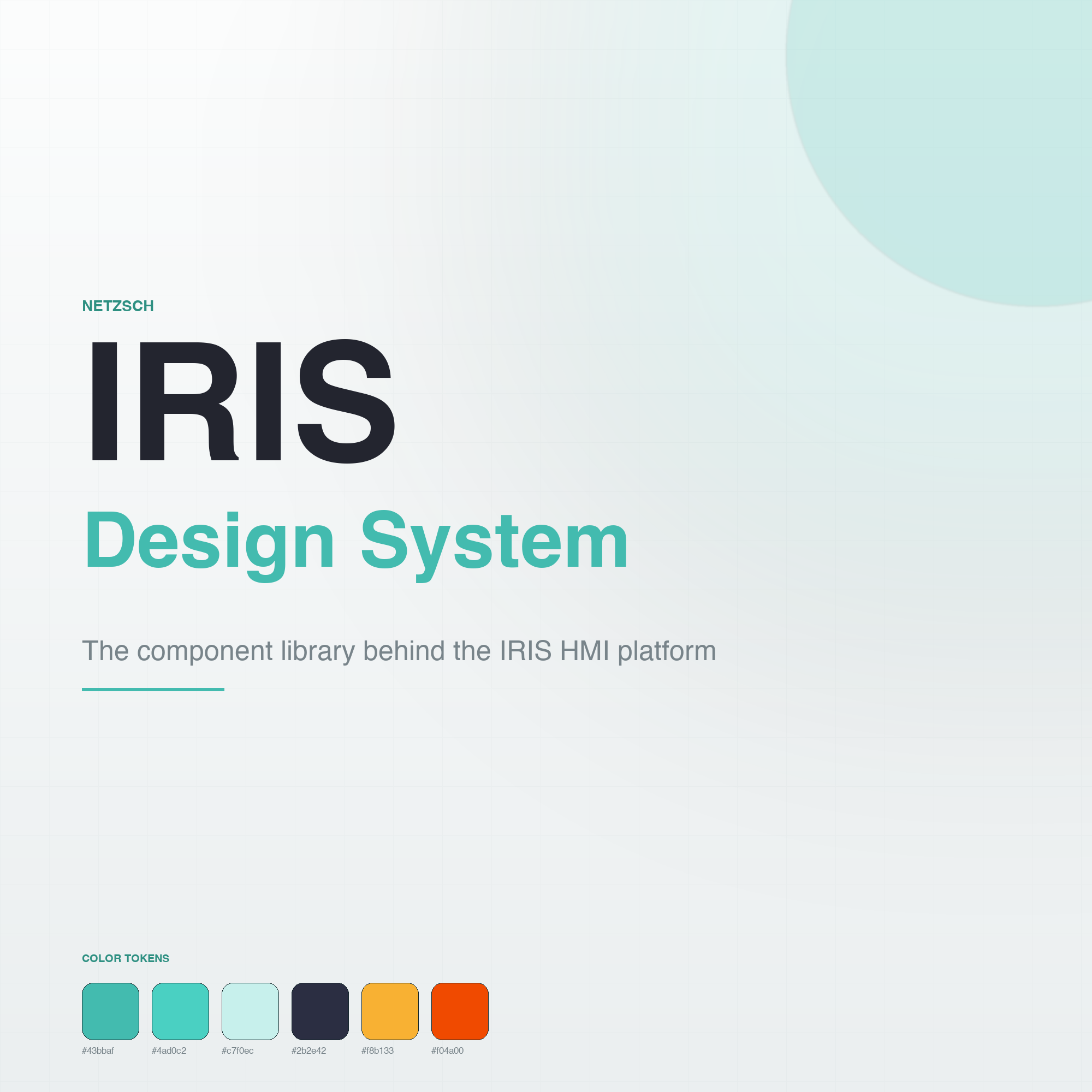
IRIS Design System
The component library behind IRIS V3: the design system every NETZSCH G&D machine HMI is built from. Tokens, 29 component families, and a variant set for each panel size.
- 29
- Component families
- 2
- Panel size variants
- 6
- Products built on it
Challenge
Industrial HMIs have patterns generic design systems don't carry: batch cards, recipe steps, machine status buttons, gauges, start/stop sequences with confirmation states. And every component has to exist twice, because the machines ship with either a 12-inch or a 15-inch panel and the touch targets can't simply scale.
Without a shared library, each of the six IRIS product lines would have kept solving these locally, which is exactly the divergence IRIS V3 existed to end.
Approach
I built the library in Figma as the single source for all six product lines: a tokens layer (the NETZSCH teal ramp, neutrals, signal colors, spacing, radii) feeding 29 component families, each published with 12" and 15" variants and their full state sets.
The domain components are the point. Snackbars and text fields exist in any DS; batch cards, dosing gauges, hourmeter displays, and operation bars are what make this one industrial. Those came from the products, were generalized, and went back into the library.
Outcome
All six IRIS V3 product lines ship from this library, and new HMI screens start from published components instead of copies of old screens. It's the quiet half of the IRIS V3 case: the platform redesign got the attention, the library is what made it repeatable.
Selected screens
SuperDigital
→Pix MVP for Santander's digital account: pay, receive, and manage keys. Fintech serving millions across Latin America.