Nerida
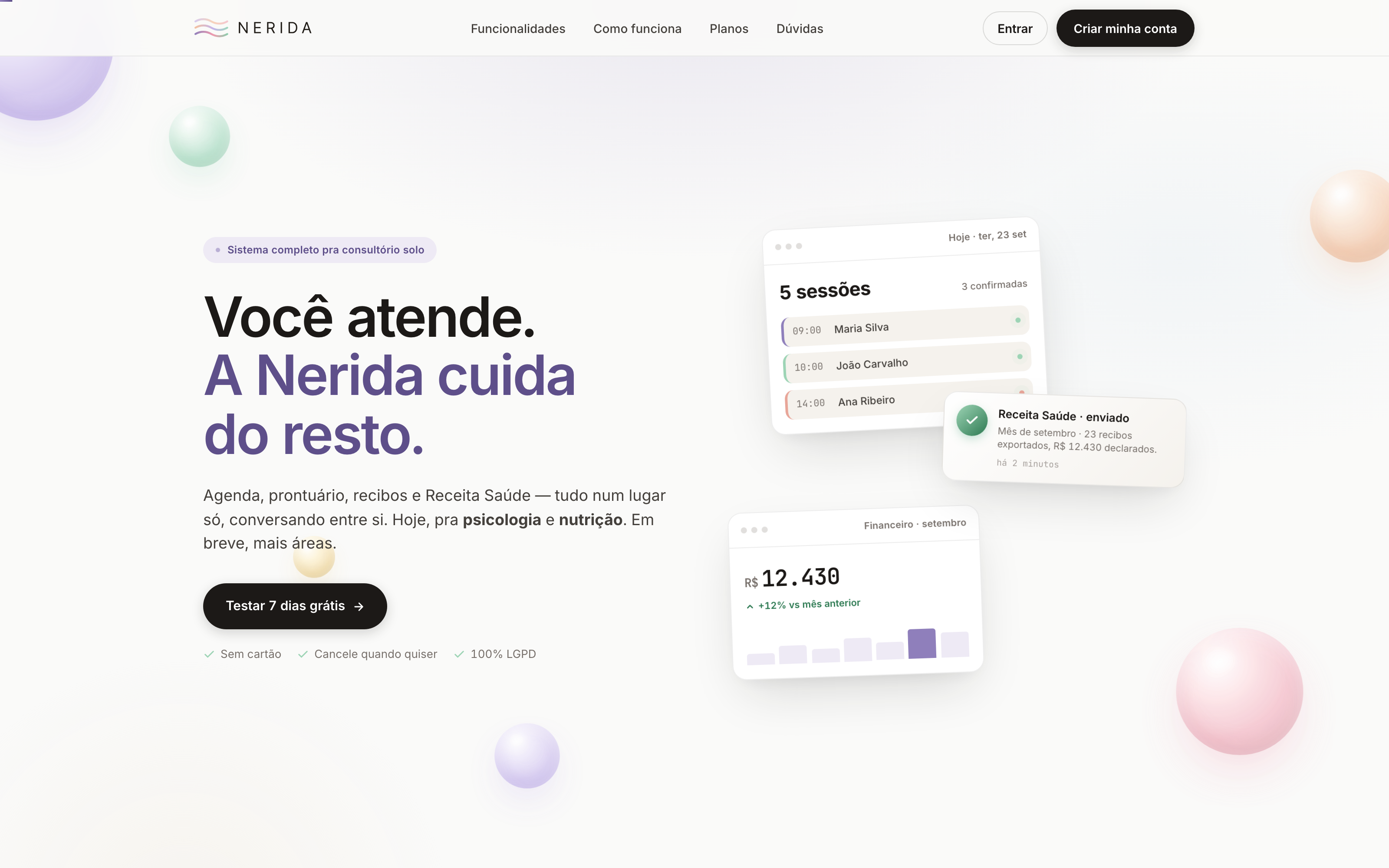
Nerida is a modular platform for solo health professionals in Brazil. Psychology is in production, nutrition in beta. Agenda, structured records, native Pix, a financial module that handles Carnê Leão, and meal plans with a public patient link. All of it designed, built, and operated by one person.
- 100+
- Active clients
- 12 days
- Zero to live
- 51+
- Database migrations
Challenge
Psychologists who run their own practice in Brazil have a handful of software options, and they all stop in the same spot: they store patients, they log payments, and that's about it. Tools like PsicoManager and Psicoplanner keep the appointment book, but they don't touch the things that actually keep people up at night. The money is irregular, asking a patient to pay feels awkward, and tax season with Receita Saúde and Carnê Leão is a mess.
The same pattern came up over and over in conversations with psychologists I know: people pay late and asking for it feels uncomfortable, income swings make planning impossible, and tax season turns into a frantic Excel rebuild. The existing tools were built for the appointment side. The money side was the gap.
Approach
I already had an internal clinical tool I'd been building for clinics with teams, so I forked it and stripped it down for one person: no team views, no clinic switcher, no roles. Fork to live took twelve days.
The rhythm was short sprints, one to three days each, with Claude Code as my build partner. I owned the product direction, the design, the copy, and every security call. Claude did the heavy typing: the plumbing, the database changes, the payment and email integrations. I wrote a brief, reviewed every change, shipped, repeated.
A month after launch it became a platform. Each profession gets its own module and every account's data is walled off from the others, so the same core serves psychologists in production and nutritionists in beta, each with its own navigation, records, and tools.
Outcome
Nerida runs in production with real paying users: over a hundred active clients. Two plans (R$49 and R$89 a month, less on the annual), a 7-day trial, and Pix through Asaas.
Live today for psychologists: an agenda with reminders, structured records (anamnese, session notes, contracts), patient management with CSV import, and the financial module across five tabs: overview, payments, a gentle two-step way to chase what's owed, subscriptions, and a fiscal tab that exports the Carnê Leão CSV in the exact Receita Federal format. For nutritionists, in beta: anthropometry, a meal-plan builder with a public patient link that updates in real time, and a 24-hour recall.
The public landing at nerida.com.br ships separately as a static page with custom motion and a full SEO setup, and it now tells the multi-profession story: psychology and nutrition are live, and more areas get added as demand shows up. Fifty-one database migrations in, the whole thing has survived a launch, a pivot to serving more than one profession, and a second one going live.
Who I designed for
One persona. Brazilian psychologist running a solo practice: usually 20-50 patients, often working from home, frequently on the CPF tax regime. Not a tech buyer. They want software that disappears and lets them focus on the session.
That single-persona constraint changed every design decision. No team views. No multi-clinic switcher. No role permissions. The product is built around one person, not a workflow team.
The lilac brand and the glass-sphere login both fight the same enemy: clinical software that feels cold and bureaucratic. Nerida is meant to feel calm.
The key decision: the financial module
Competitors stop at "mark this payment as paid." Nerida starts there.
The financial module has five tabs. Overview shows projected end-of-month income, separating confirmed from outstanding. Payments is the listing. Collections runs a humanized two-step charge (cordial first, firm later, opt-in by patient). Subscriptions handles monthly recurring plans. Fiscal exports Carnê Leão CSVs in the exact Receita Federal format, tracks deductible expenses, and estimates IRPF.
Other tools show you what you charged. Nerida shows you what's left, helps you ask for it without discomfort, and handles tax season without an Excel rebuild. That's the gap I kept hearing about in conversations, and it's where the product lives.
What didn't go well
The pivot to a multi-profession platform came early, three weeks after launch, before I had usage data to justify it. The module system is good engineering and it made the nutrition beta possible, but the decision was driven by ambition, not by users asking for it. If nutrition doesn't convert, that month belonged to psychologist-facing features.
The marketing also lagged the product: for about a month the landing page kept telling the single-vertical story while the platform had already moved on. It caught up in late May, but the gap is the honest cost of a one-person company where product, ops, and marketing take turns getting attention.
Selected screens
" Twelve days from fork to live, another month to become a platform. The pace with Claude Code teaches you that the constraint isn't typing speed; it's decision quality. The AI never owned a decision; it owned the keystrokes that came after. "
Norius
→Redesign of an industrial IoT monitoring platform, from discovery to Storybook. 33 component families, 179 stories, a navigable prototype.